

|
For any assistance, call +32 2 515 08 44 or email we@iccwbo.be |

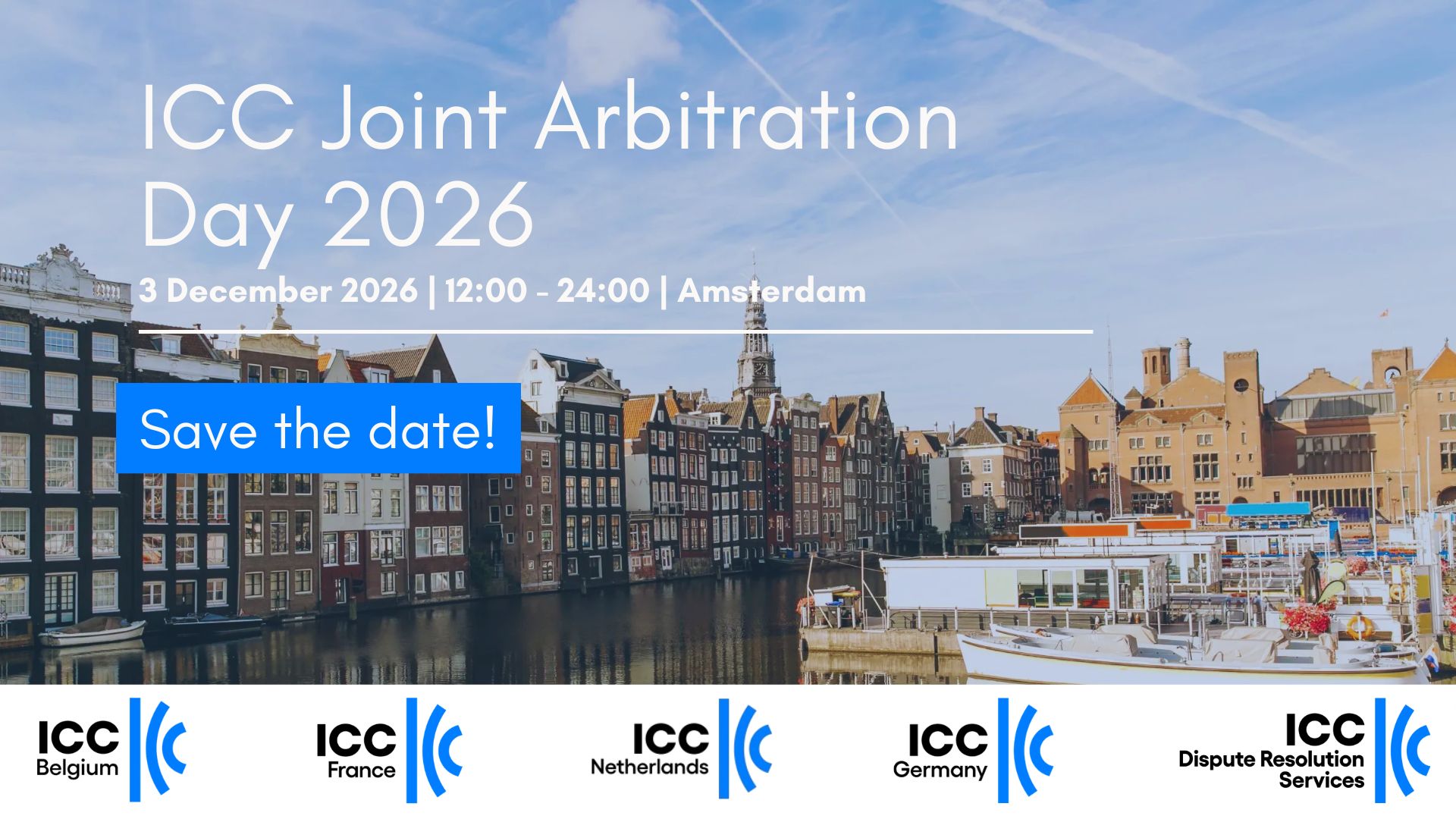
Joint Arbitration Day 2026
3 December
Joint Arbitration Day – Second Edition
ICC Belgium, together with ICC Netherlands, ICC France and ICC Germany, is pleased to host the second edition of the Joint Arbitration Day.
A full afternoon of practical, cross-border discussion on the issues actually shaping international commercial arbitration in Europe right now: from the European Union’s evolving relationship with arbitration, to the new 2026 ICC Rules, to the disclosure questions raised by the use of AI. The day brings together arbitrators, in-house counsel, external counsel and the bench from different jurisdictions, with the user voice deliberately built into every session.
Programme
12:00 – Networking lunch
13:00 – Welcome
13:15 – Keynote: Geopolitics – Europe’s uncomfortable position
14:00 –Panel 1: How is EU law shaping commercial arbitration?
14:45 – Coffee break
15:15 – Parallel break-out sessions
16:30 – Panel 2: View from the bench
17:00 – Networking drinks
19:00 – Dinner (central Amsterdam)
Sessions
Keynote: Geopolitics – Europe’s uncomfortable position
A non-legal opening on the geopolitical reshaping that is squeezing European business between US technological leverage, Chinese economic dominance and Russian military pressure. Paul Verhagen, Senior Fellow at The Hague Centre for Strategic Studies, Strategic Liaison at the UvA Civic AI Lab and lecturer at the University of Amsterdam examines how the global technology landscape is fracturing into competing US, Chinese and European blocs, and what this strategic shift means for European business across AI, critical infrastructure and trade. Drawing on the thesis of his forthcoming book, The Techtonic Shift: Power, Tech and the End of Nations.
Panel 1: How is EU law shaping commercial arbitration?
EU law has moved from the background to the foreground of commercial arbitration. Following the CJEU’s Achmea and Komstroy line of case law, alongside state aid issues and the responses of national courts across jurisdictions, tribunals, users and counsel are increasingly required to grapple with questions that would have seemed remote only a few years ago.
Parallel break-out sessions
Small-format sessions running in parallel, designed for substantive engagement rather than passive listening.
1. AI in Arbitration: Disclosure, the ICC Task Force and the EU AI Act
Artificial intelligence is reshaping how arbitrators work – but the rules governing its use are still being written. This session focuses on two concrete pressure points: the disclosure obligations arbitrators face when using AI tools, including the ongoing work of the ICC AI Task Force; and the implications of the EU AI Act for arbitrators seated in EU jurisdictions. Both issues are live now and affect practitioners across Belgium, France, Germany and the Netherlands. Less a survey of AI in arbitration, more a practical reckoning with obligations that already apply.
2. Drafting Arbitration Clauses for 2026: EPP and Highly Expedited Arbitration
The 2026 ICC Rules introduce the Highly Expedited Arbitration procedure – but opting in (or out) requires deliberate drafting choices that many standard clauses do not yet reflect. This session is designed for in-house counsel: what does the new procedure actually offer, where does it create risk, and how should arbitration clauses be drafted or revised to reflect it? Workshop format, with clause language under the microscope.
3. The 2026 ICC Rules: New Disclosure Obligations and What They Mean in Practice
The 2026 ICC Rules impose a new obligation on parties to identify and explain relevant entities – a change with real consequences for group structures, joint ventures and supply chains common in industrial and infrastructure projects. This session unpacks what the new obligation requires, how the updated Note to Parties interacts with it, and what in-house and external counsel should be doing now to prepare.
4. Preventing Disputes: Is the Mediation Window Friend or Foe?
Multi-tiered dispute resolution clauses are standard in complex projects – but does the mediation window actually prevent disputes, or does it merely delay and complicate them? This session examines the question from the perspective of industrial and infrastructure projects, where the stakes are high and relationships long. We will look at what works, what does not, and how the clause is drafted in practice across our partnering jurisdictions.
Panel 2: View from the bench
A panel of senior judges from different jurisdictions on enforcement, set-aside and the EU-law interface. A genuinely “joint” closing that ties back to Panel 1 and brings the day full circle.
When?
Thursday, 3 December 2026.
Where?
- Day venue & Networking drinks: De Brauw, Amsterdam Zuid.
- Dinner: central Amsterdam – exact venue to be confirmed.
- Accommodation: as the evening programme takes place in the city centre, we suggest booking accommodation there.
Fee?
- EUR 125,00 excl. VAT (21 %) for members of ICC Belgium
- EUR 350,00 excl. VAT (21 %) for non-members
Cancellation policy?
Registration is required.
Please note that cancellations must be received in writing no later than Thursday, 26 November 2026. Registrants, including ICC members, who do not cancel by this deadline and do not attend will be charged the full registration fee of €350.